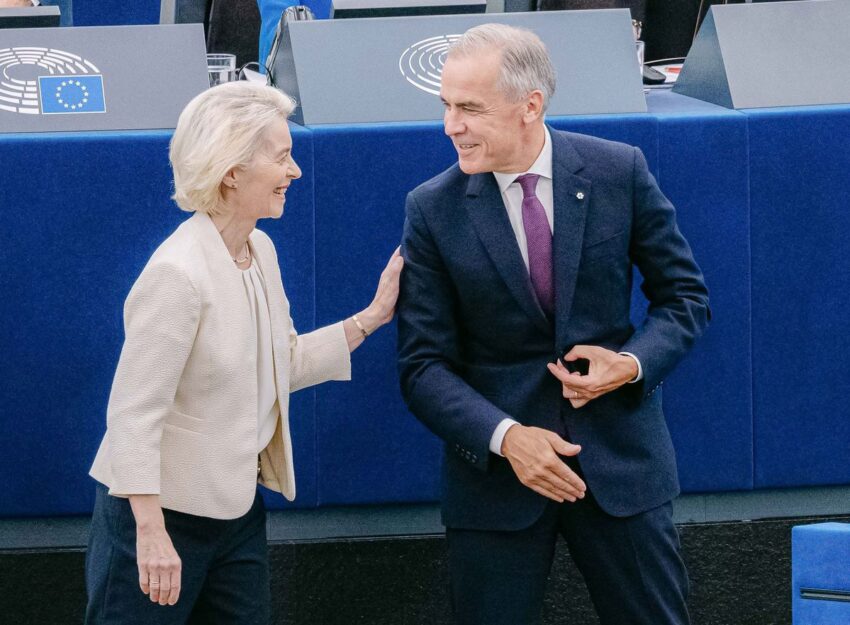
European Commission President Ursula von der Leyen, left greeting Canada’s Prime Minister Mark Carney during her address to the European Parliament in Strasbourg, EU released photo.
The proposal that Canada could become an associate member of the European Union is of historic moment and something which Australia should take heed.
The geopolitical tectonic plates are shifting for good reason. An Axis of Autocracy has arisen. Trump, Xi, Putin and Netanyahu have in the past decade at least inflicted profound suffering on their own people and the people elsewhere that they seek to subjugate to their will.
The world would be a better place if they had never been born or if they had all died before they had turned 30. The same sentiment was rightly expressed about Hitler, Mussolini, Stalin, and Tojo.
Right now, Europe is the vanguard against this new Axis of Autocracy. Autocracy has grown out of the circumstances of each state. The four autocrats have not formed any formal alliance but they are joined in a common purpose of supporting autocracy and undermining democracy and the rule of law.
Autocrats Trump and Netanyahu have acted in a way that has galvanised China, Iran and Russia into active collaboration with each other. Trump’s immoral withdrawal of support from Ukraine has emboldened the Russian autocrat.
The EU, on the other hand, stands for the rule of law, free trade, and government by consent. Its remit should not be restricted by the Treaty of Rome’s requirement that a nation has to be in the geographic ambit of Europe to join. It would be great if other rule-of-law, free-trade liberal democracies could join it in a rule-of-law alliance to crush the Axis of Autocracy so that millions more human beings can live lives with freedom from fear and want.
Those other rule-of-law liberal democracies could join a new co-operative and free-trade alliance that could include Australia, Japan, South Korea, Singapore, New Zealand, Malaysia and perhaps in time India, the Philippines and even Indonesia, Malaysia and Vietnam.
The rule of law is critical. It is different from rule by law. The rule of law in US has been eroded dramatically under Trump. In a rule-of-law country, the law is available to constrain power. In a rule-by-law countries, the holders of power use the law to enhance their power by crushing enemies and opponents and the free media, and anyone or anything else that threatens their position.
The way Trump uses the law exemplifies the distinction. He has used concocted criminal charges and defamation actions against opponents, much as Lee Kwan Yew did in 1970s Singapore and Park Chung-Hee did in South Korea. Now law in Singapore and South Korea is politically neutral and capable of defending the citizen against the state as much as the other way around.
Trump has also pushed back against the principle that government can only be legitimate if it comes with the consent of the governed. It was a founding principle of the United States and the American Revolution that America rejected the divine right of kings.
That is the difference between governing and ruling. The four dominating autocrats today lean towards divine right and ruling, not governing. Putin invokes the imprimatur of the Russian Orthodox Church. Patriarch Kirill has supported Putin’s illegal war against Ukraine.
Trump has used the Jesus image to portray himself and in June said, “We rule by common sense to a large extent.” Note “rule” not “govern”. And it is his imagined innate commonsense that backs his executive orders, just like a king. He rejected the 2020 election result in which voters consented to a Biden presidency and did not consent to a Trump one.
Netanyahu frequently invokes Biblical texts and a religious justification for his aggression in Gaza and the West Bank.
Xi and the Chinese Communist Party have assumed the Mandate of Heaven as Chinese dynasties have in the past to “prove” their legitimacy, rather than the consent of the governed. The Mandate of Heaven is a concept that if the rulers provide prosperity for their people, their rule is justified.
The contest in the US in the next two and a half years will be between whether the consent of the governed means anything or whether Trump will continue to assert autocratic power irrespective of what voters say in the mid-term elections.
In the face of this, it makes sense for countries who share the values of the governed consenting, the rule of law, and free trade to associate more closely.
A free trade bloc between the EU, Canada, Australia, South Korea, Japan, Singapore, and New Zealand would be huge – $35 trillion. It would be bigger than the US or China. It would create an incentive for other nations to rush to meet the criteria to join in the same way that Eastern Bloc countries rushed to join the EU after 1990. They have been proven right. Countries like Romania, Slovenia, Czechia, and Slovakia have had impressive growth figures since 1990 greatly lifting living standards. More fool Britain for leaving. The evidence of that folly is everywhere.
Free trade does that. We know that from our own lives. We cannot produce all the goods and services we need ourselves, so we trade what we do well for what others do well to the benefit of both.
Even if we acknowledge that unbridled neo-economic liberalism has got us into our present predicament – over-powered billionaires, increasing inequality, falling productivity, internet-induced introverted isolation and so on – the free-trade part of that bundle is not part of the predicament. Trump’s trariffs are daily proving that.
The beauty of an EU-based global trading system is that the very things that people criticise the EU for – bureaucratisation, consensus, long negotiations and so on – are now proving to be its very strengths. Once a nation goes through that process the agreement becomes long-term, stable, and reliable.
Contrast that with the way nations are being treated by the US. Long-term free-trade agreements with allies like, Canada, Mexico, Australia, and Britain have been unilaterally shredded by a maniacal, mecurical, unpredictable, power-abusing autocratic in the Oval Office.
Free trade even brought millions of Chinese out of poverty after it joined the World Trade Organisation in 2001 when its GDP was just $1.35 trillion – the same size as that of France. It is now more than 15 times that at $20.85 trillion, five times that of France. The pity is that China has since turned its back on the WTO and the rules-based order.
Business thrives on certainty and rules (the rule of law) and contracts in the face of arbitrary confiscation as practiced by Putin and Xi and in the face of uncertainty and rule breaking, as practised by Trump.
As I argued in March last year (https://www.crispinhull.com.au/wp-admin/post.php?post=13164&action=edit ), it is time for a new, large association of rule-of-law democratic countries that would be economically greater than the US, China and Russia combined and would put the autocrats in their rightful place – impotency.
Crispin Hull
This article was first published in The Canberra Times and other Australian mastheads on 22 September 2026.
www.crispinhull.com.au