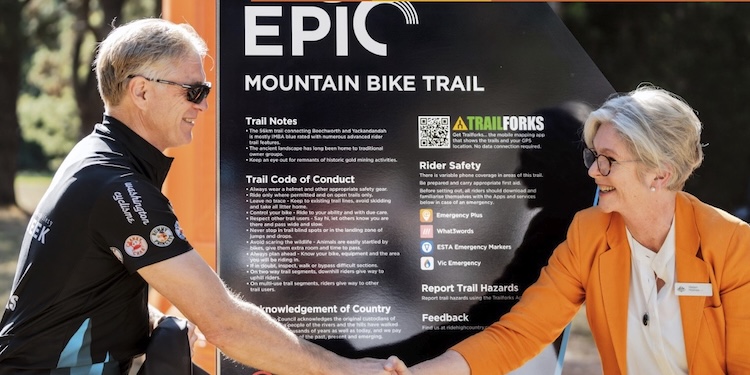
Helen Haines’s electoral office is in Murphy Street, Wangaratta’s main Street. Most Members of Parliament have their electoral offices in prominent locations and their names are emblazoned on the street-front windows.
It is a statement: “I am here among you, to help you.” When an electorate changes from one party to another or to an Independent, the new MP invariably takes the electorate office of the former MP. It reinforces the statement, “This is a representative democracy, I represent you, irrespective of party.”
Voters often seek help directly from Federal MPs. Often their concerns are personal to them. They often come about through dealings with the bureaucracy. Often they concern state or even local government issues. Invariably, the come from ordinary voters who have neither the money nor the connections to use layers or lobbyists to get the result they want.
This is why yesterday’s attack on Haines was such a grievous assault on our democracy. Most likely, it will result in yet further security measures that will do only more to isolate politicians from their communities – ironically the very alleged remoteness that so many on the political fringe complain about.
Where is this violence coming from? Last night, another MP, the member for the ACT seat of Fenner, Andrew Leigh, asked that very question giving the Joan Kirner Social Justice Oration.
He argues that many places, including Australia, have had cost-of-living pressures, inflation, and inequality in the past and there was not the same level of politically directed anger and violence that we are seeing today. The difference, he says, is not economic conditions but the way people receive their information.
Social media is now the Number 1 source of news, displacing traditional media.
Traditional media had gate-keepers, sub-editors and news directors, who decided what would be published and its prominence and, more importantly, what would not be published.
When I taught journalism at the University of Canberra, I had a lecture titled “What sub-editors do?” As well as fixing spelling and grammar, a critical task was to filter out the defamatory, illegal, and offensive. Incitements to violence were out.
The business model was that you would lose readers by publishing the offensive. Outrage was expressed as: “I am cancelling my subscription.”
Now, there are no gate-keepers. The author is the publisher.
Worse, rather than weeding out the tasteless, violent, offensive, and abusive, the business model of social media actively encourages outrage and anger. The response to outrage is to click for more. Outrage and anger attract hits. Hits attract advertising dollars. Social media is now the business of anger and outrage.
Social media used to be just that: messages between friends. If your friends liked something, you might like it. If you spend time looking at it, the social media platform gets more money. Then came the algorithms and putting stuff into feeds. Messages from friends became an ever-smaller portion of what people saw.
It is no longer “social” media. It is anti-social media. It presents people with a tightening, isolating feed. And if someone stumbles into a feed that contains extremist content the algorithms put more of that stuff in the feed and eventually makes violence seem normal.
Leigh cites research showing that only 7 per cent of time spent on Instagram was from the viewer’s friends.
The algorithms promote emotional language, rather than the rational. Eventually, political opponents are seen as enemies. You do not respectfully debate and discuss with those with whom you disagree. They are now your enemies and you inflict violence upon them. Of equal concern is that the algorithms work to make people feel that members of the opposite sex are enemies and that it is acceptable to direct violence towards women or feminist ideals.
This business model and the technology that underpins it comes from the US. And one of its most pernicious and influential users of it is President Trump himself – belittling, abusing, and glorifying violence with impunity.
Baroness Beeban Kidron, a member of the UK’s House of Lords and a former film director, argues that governments have to act against the tech giants and their business model which does such harm. “We are at tech’s tobacco moment,” she says.
We do not know whether Haines’s attacker was influenced by social media, but the likelihood is that he may have been. And with social media presenting ever tighter and compelling feeds, there is less time of friends, family and social connections which are the pillars of social norms that say that violence is always unacceptable.
Anger is fine when it is directed at conditions like injustice, in order to seek change, but when it becomes directed at people in the form of violence or hate-inciting speech, it is time for us to act.
That action must be directed at the worst elements of the way we receive our news and information, to put in some new gate-keepers and some sanctions, especially in the political sphere. Last week, One Nation’s gratuitously nasty and cruel political cartoon mocking Senator Jacqui Lambe’s medical condition went without sanction. Indeed, One Nation doubled down with a “get-over-it, have-a-laugh” message. That doubling down carried the message that the original cartoon and its nastiness was acceptable. One Nation’s claim it was legitimate political comment is nonsense.
The tobacco analogy is pertinent. The tobacco “industry” often cited “freedom” in its campaigns against regulation. Big tech should not be allowed to get away with a “freedom-of-speech” argument as society tries to protect people against the destructive poison released by social-media algorithms.
Also, we need constant attention to gun laws. The attacker in Wangaratta had a knife in his car. If this attacker had got a gun, the results could have been much worse.
Crispin Hull
This article first appeared in The Canberra Times and other Australian media on 21 October 2026.
Excellent… totallyagree. It’s really past time for some strong political courage to take on the technology oligarchy. Protecting our democracy is paramount.