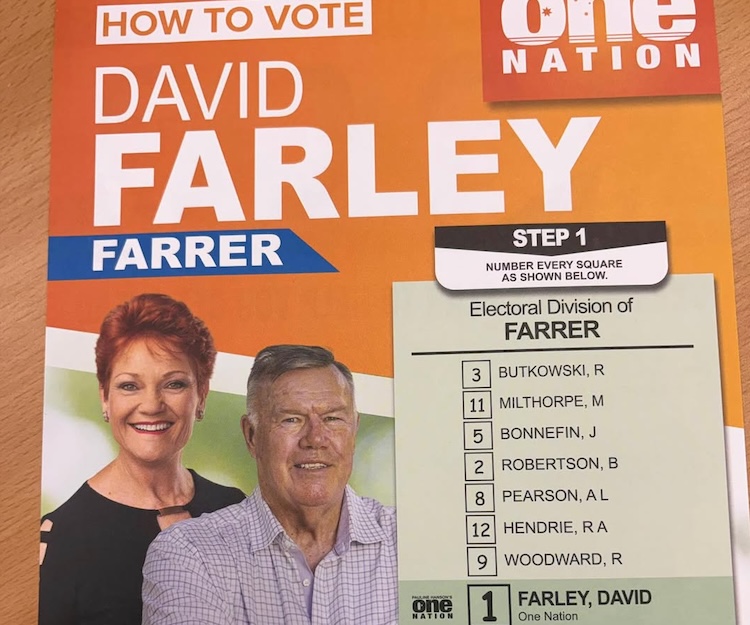
The result for Labor in the Farrer by-election was truly ghastly. Labor did not field a candidate, so it has largely been ignored.
The pertinent question to ask, though, is: What happened to the votes of those 15,551 people (15 percent of the electorate) who voted for Labor at the general election in 2025?
You would think that if they were happy with the government and still general supporters of Labor and its values and thinking they would have voted for the Greens or the sensible-centre, climate-aware independent Michelle Milthorpe. But the figures suggest to the contrary.
Milthorpe increased her primary vote by 8.5 percentage points to 28.5 per cent.
Even if the whole 8.5 percentage points were former Labor voters, it still leaves 6.5 percentage points lost to Labor. Virtually no former Labor voters went to the Greens because the Greens vote fell by a half. My guess is that most of the 2.5 percentage points the Greens lost went to Milthorpe as strategic voting.
That is 2.5 percentage points of her 8.5 that did not come from former Labor voters.
Also, we know that Teal-type independents tend to keep their vote or add to it. We found that out when all by one of the independents re-contesting in 2025 won. And the one who lost retained her 2022 primary vote.
It suggests that at least some of Milthorpe’s 8.5 increase came from Liberal and National voters. Again, suggesting that even fewer of the 2025 Labor voters did not stay on the progressive side of the ledger. Probably, only a third did.
So, where did more than 10 percentage points or more (two thirds of the Labor vote) go? A lot (say, a bit more than half) went all over the place as you would expect when there is no candidate to anchor them.
Virtually none would have gone to the Liberals or Nationals. So, it leads to the inescapable conclusion that, say, half of that 10 percentage points (a third of the Labor vote) went to One Nation. Gulp.
It would be folly to dismiss this as an insignificant phenomenon that happened in a rural backwater full of One-Nation, National-Party hicks.
A better way to look at it is to view the Labor voters of Farrer as a sub-set of Labor voters nation-wide. Albury and Griffith, for example, have the attributes of the inner parts of major cities and their people think in similar ways.
Nationally, the third of the Labor vote lost in Farrer, would constitute a 10 per cent swing. But let’s allow for some other factors that would lessen the blow. We have already factored in the absence of a candidate.
Other factors would include the fact it was a by-election in which protest votes are usually strong. Also, a lot of concentrated effort went into the One Nation campaign which it would not be able to replicate across all the electorates in a general election.
Another factor is that in rural Farrer there would have been a bandwagon effect caused by it being more acceptable to acknowledge out loud one’s support for One Nation. Humans like to belong. It explains why rural seats, where there are lots of small communities, often deliver large majorities.
Those factors would be considerable, but not total. Say, around a half.
It still leaves about a 5 or 6 percent swing against Labor. Six percent would send it into minority government. Labor has a whopping majority with 60 per cent of the seats. But it is underpinned by just 34.5 per cent of the primary vote. You only have to kick away a little of that for the seats to tumble.
National Party defector now One Nation MP Barnaby Joyce sounded the warning to Labor saying that One Nation was coming after Labor in western Sydney.
Another, inescapable conclusion of the byelection is that the Liberal and National Parties handed the result to One Nation on a plate by directing preferences to One Nation ahead of the independent on their how-to-vote cards.
The count suggests that One Nation got more than two-thirds of the Coalition parties’ preferences. If they had directed preferences the other way and the two-thirds had gone to independent Michelle Milthorpe, she would have narrowly won.
It was an act of shameful cynicism, no doubt driven by the strong tendency for independents, once elected, to get re-elected and for successful One Nation candidates to quickly crash and burn. With a One Nation win, the Coalition might expect to get the seat back before long. With an independent winning it would be very much longer.
Milthorpe should not give up but stand again in the general election.
And the major parties, especially Labor, should address the grievances which drive One Nation’s vote; expose its wealthy-donors base; and chase down where its public-funding and donation money goes.
The conservative side of politics has been here before. After decades of conservatives selling small people out to big business in the Depression and war, Robert Menzies founded the Liberal Party in the 1940s on the basis of the “Forgotten People” – the very people Pauline Hanson is talking to now after three decades of that same Liberal Party selling out lower and middle-income people to big money with privatisations, deregulation and immigration-spawned cheap labour that has resulted in a new generation of “Forgotten People”.
As Hanson said after the by-election, “struggling Australians” are “not going to be the forgotten people anymore”.
If the best the major parties can do is hope for a One Nation implosion, they are taking a massive risk, especially on the Labor side.
Another over-looked fact in this by-election was the One Nation preference allocation to the two Coalition parties before everyone else.
It did not matter in Farrer. But it will matter in many other seats in a general election. Labor should do everything it can to avoid what happened between 1949 and 1972 in Australian politics – a right-wing fragment party purporting to represent the hard-done-by preferencing the Coalition and keeping the Coalition in power against the interests of those very hard-done-by people.
A possible looming wipe-out for the Liberal and National was one lesson from Farrer. A more important one might be the dangers for Labor.
Crispin Hull
This article first appeared in The Canberra Times and other Australian media on 11 May 2026.
Excellent analysis and spot on with the danger of One Nation to Labor as evidenced in the Farrer by-election.
Yes Crispin, 2025 Farrer Labor votes must have gone to One Nation. 2025 Labor 15,551 and Liberal/Nationals lost 22,975 of their 2025 votes in 2026. They went to PHON an extra 32,065 votes over their 2025 number. And Michelle Millthorpe got an extra 7,394 votes. So 2025 Labor and LNP votes lost in 2026 were 38,526 and PHON and Millthorpe picked up 39,459 votes and the extra thousand came from the minor parties. There were 4,561 less formal votes in Farrer in 2026 than there were in 2025.
As Helen Haines, MP for Indi, said after the bi-election about both Nationals and Liberals giving their preferences to One Nation, “they smoothed the runway for One Nation”. Shame on them.